
 Ohio — Open to Work
Jun, 2026
Price Transparency Chatbot
The missing layer so pricing stops being a surprise
01. Overview
Finding out the cost before sitting in the chair
Salon pricing shifts with hair length and complexity, leading to mismatched expectations and awkward conversations at the chair. This chatbot qualifies the service while it books, surfacing honest price range before the appointment, not after.
AI Involvement
AI touched mapping, synthetic testing, and prototyping. Claude Code ran five proto-personas against the flow map and bot script before the wireframes existed, so the flow could be stress-tested before it was locked into a visual design. Synthesis and every decision in Section 04 stayed human-led.
02. The Problem
Trust gets built with a conversation
Add a conversation layer that asks the right questions before booking, and the guessing stops.
Client Impact
Fear of being overcharging keeps clients from ever booking the consultation
A “free consultation” still costs time and travel, sometimes only to learn the service is out of budget
Business Impact
Unclear pricing loses interest before the salon gets a message
Emails, forums and consultations are the current workaround: time-consuming, and still no guarantee of a sale.
Reframe
01 Browse
Visits the salon site
02 Conversation Layer
Asks real questions, gets a real estimate
03 Book & Show Up
Schedules with a number already in mind
03. The Research
Most booking softwares solves the when, not the what
We initially set out to find whether salons use chatbots at all. Browsing through numerous salon websites, what we found instead was that pricing is mostly surfaced through the booking portal itself.
Target
Findings
Pricing lives in the booking process, not on the website
Vagaro, Boulevard, Meevo and Fresha all tie pricing display directly to backend scheduling
Meaning
The middle layer of understanding what you’re booking and what it will cost is the part nobody owns. That’s the gap a chatbot could fill
Existing AI chatbots are not in active use
Oscar Chat, Conferbot and Jotform were absent from every salon site we browsed
Meaning
Low adoption of AI tools in the space, likely asks more technical work than an independent salon owner has time for
Two audiences arrive at the same conversation through different gates
Some need to know what they can afford before committing, while others need confidence in the salon
Meaning
The chatbot needs to serve both gates in one flow. An entry point can’t assume everyone shows up for the same reason
04. Design Decisions
Most chatbot tools lean on AI for adaptiveness. For booking a service, every added layer between a client and the end goal is a chance for them to give up. The goal was to be direct enough that clients always understand why they’re being asked something and where it leads.
Dropped
AI-powered adaptive bot
Adaptive responses that learn from client history and expand automatically as the model sees more conversations
Broke On: setup and upkeep. Needs ongoing tuning, plus monitoring that most independent salons can’t staff for
Dropped
Free-type input
Let clients describe what they want in their own words, then parse the answer with keyword matching
Broke On: vocabulary. Most clients don’t know the term the hair industry uses, and keyword matching breaks the moment someone types outside the list
Shipped
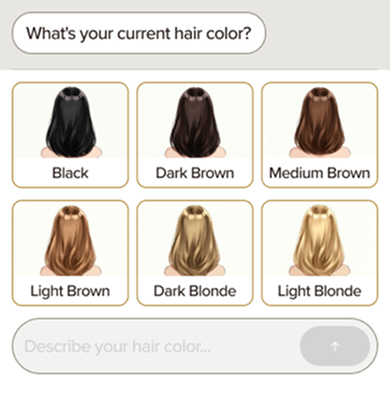
Rule-based flow, mostly tappable chips
Chips funnel clients toward an answer faster, with free-type reserved for a few key moments and chips as the fallback when nothing matches
Held: traceability. Structural math is what makes the estimate trustworthy. Every price comes from an explicit combination of service, length and stylist tier.
How memory becomes measurable
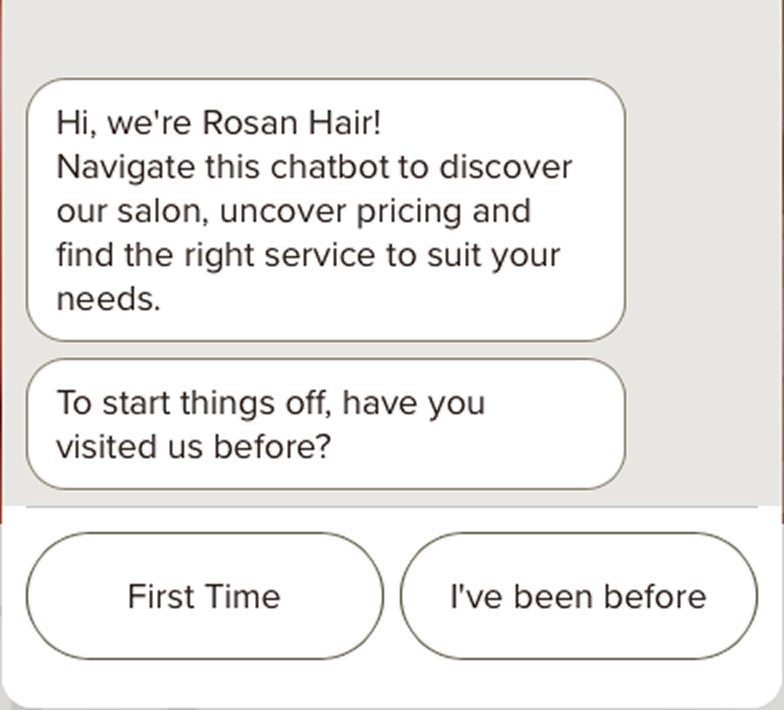
Memory starts at entry, asked once and held for the session. From there, it scopes to whichever path the client takes. It’s held just long enough to serve the conversation.
Side Note: The data exists in session but isn’t persisted anywhere. The structure was deliberately built in a direction that makes real measurement possible later.
Loyalty Rate
The new/returning flag, tracked over time, becomes the share of bookings that come from repeat clients versus first-timers
05. Walkthrough
Every path leads somewhere real
Try this path:
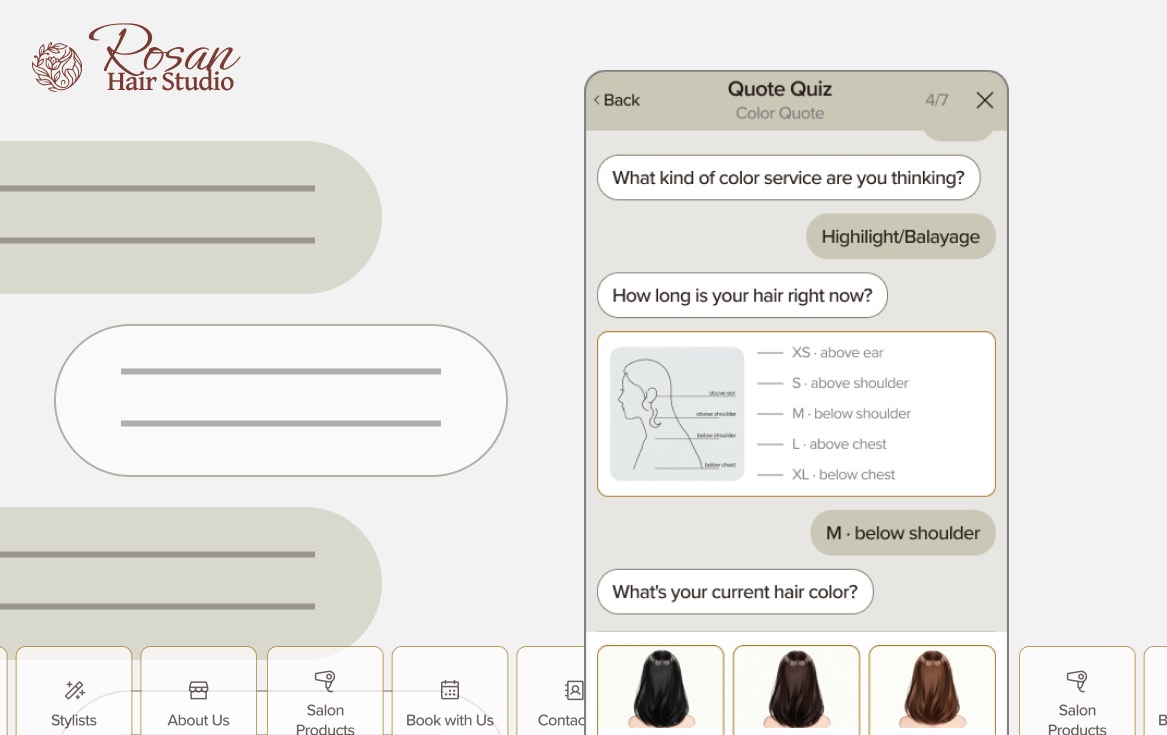
① Main Menu → ② Service Menu → ③ Color → ④ Highlights/Balayage → ⑤ Answer questions → ⑥ See your estimate
Works
The full quote flow: service selection, the qualifying questions, rule matching, and the estimate shown as a range. The style discovery quiz runs the same pipeline, scoring points instead of matching rules.
Static
Booking confirmation, client onboarding and the drop-off re-engagement timer. No live pricing feed, which is why the bot leans on range language instead of stating a guaranteed number.
Interact with the live prototype
To View in a New Tab
Open Prototype Link06. Reflections
01 Scope
Scope cut to protect the core thesis
The main focus was a clearer pricing system that could actually convert into bookings, so a few areas were designed but not fully wired (such as, onboarding new client, drop-off re-engagement timer, and a backend for updating the pricing system. They were additions on top of the core thesis: worth continuing, but set aside to stay on the main problem
02 Robustness
Widen the keyword net against messier input
Free-type only comes up at a few key moments, but the keyword matching behind still needs more testing against real input, like typos, phrases and combinations. As usage grows, widening that net would cut down that friction
03 Measurement
Finish the metric work with a real backend
If the project continued, the next focus would be a real, trackable backend instead of in-session data only. After that, running the quiz and quote flow through more answer combinations to confirm common pairings still price accurately, and refining what the client sees at the end.